Sunday, April 24, 2016

Year of the Monkey? Why you should not own one.

     I meant to post this back in late January/early February, as the Chinese New Year and the Year of the Monkey (which is my Chinese Zodiac Animal Sign) hit.  I'd read an article about how the Pygmy Marmoset, also known as the "Thumb Monkey", is quickly becoming a popular pet in China.  The exotic animal trade is an issue I often think about, especially as there are increasingly more viral videos of exotic pets being spread around social media, normalizing and condoning the trade.  So, what exactly is the exotic pet trade, and why is it bad?  I'll share the stories of two primates, the Pygmy Marmoset and Slow Loris.  I'll also discuss what to consider when choosing a new pet, and how you can help to stop the exotic pet trade.

What do I mean by the exotic pet trade?  
     
     Just one part of the larger exotic animal trade in wild animals and animal parts, the exotic pet trade involves the collection and sale of live animals to and from all over the world.  These animals differ from what most think of as traditional pets in being non-domesticated or wild animals often captured and taken from their natural habitat.  The exotic pet trade is a powerful force, behind only the drug and weapons trades by illegal activity and money involved.  The exotic animal trade as a whole is valued at $10 to $20 billion a year.

Tiger cubs rescued from smuggling.  More tigers are kept in captivity as pets than there are in the wild.
(Photo Credit: BBC News Asia, statistic from National Geographic)

     Now, what is the problem with this besides that red flag of illegal activity?  At the base there is the underlying philosophical issue of taking an animal out of its habitat and home, confining it to a cage, and taking away its freedom to roam and wander as it chooses.  Besides that, there are very serious animal welfare and ecological implications that are inherent in the trade.  Over 50%, and sometimes over 90% of animals in the trade die before being sold as pets.  This happens due to the stress of capture and transport, which can involve crowded, tight spaces, intentional mutilation (discussed below) of animals to make them 'safer' for humans, and lack of care leading to dehydration, starvation, and disease.  Animals that survive to sale often lead short lives, as owners are frequently unable to meet the nutritional, mental, exercise, and health care needs of wild animals.  From an ecological perspective, the exotic pet trade is both a causal factor in the declines of many species as animals are trapped and removed from the wild, and in the spread of invasive species and diseases (some of which are communicable to humans) when many owners lose interest or are unable to care for their exotic pets and release them into the wild.
Rare Yellow-crested Cockatoos discovered in the process of being smuggled on a passenger ship in Indonesia.  
(Photo Credit: AFP/Getty, found in article http://news.nationalgeographic.com/2016/02/160226-animal-trade-animal-welfare-exotic-pets-cites-wildlife-trafficking/)

Protected Burmese Star Tortoises found in an international mail package labeled as containing toys, entering the US.
(Photo Credit: US Fish & Wildlife Service, found in article http://www.cnbc.com/2012/05/16/12-Seized-Shipments:-The-Exotic-Animal-Trade.html?slide=2)

A tale of two primates in the pet trade....

     With over 5,500 species involved in the exotic pet trade, it isn't difficult to find examples,but the two I'm presenting here are currently highly coveted, being seen almost universally as cute.  First, back to the Pygmy Marmoset introduced at the start of this blog.  This is the world's smallest primate (an adult could sit in your hand), native to rainforests in the western Amazon Basin, and living in family groups of up to nine.  This species is currently declining largely because of the exotic pet trade; hundreds of thousands are trafficked in Peru each year alone, and individuals are being sold for $4500 in China.  Babies are especially prized for their usage in social media "Selfies", and are taken from the wild and from their parents.

Baby Pygmy Marmoset in a typical social media post.
 (Photo Credit: Weibo, found in article http://www.iflscience.com/plants-and-animals/no-pygmy-marmosets-are-not-cool-new-accessory)

Top/suggested searches that came up when I typed pygmy marmoset into Google Search.

     The Slow Loris is another animal suffering under the exotic pet trade.  This animal is likely familiar to you from viral videos that frequently circulate Facebook.  Slow Lorises are actually several species that are distributed across southern Asia and western Indonesia, live high in rainforest trees, are nocturnal (active at night, sleeping in the day), travel long distances to find food, and are the only known venomous primate.  This species is difficult to learn about because of its large distribution and nocturnal lifestyle, but it is known that these species are facing habitat loss to logging and agriculture, hunting for fur and use in traditional medicine, and most significantly, capture for the exotic pet trade.  In addition to inhumane transport and housing, before being sold their teeth are typically clipped or pulled to avoid venomous bites.  As pets, they are forced to live under bright lights and are additionally stressed by owners tickling them.  Videos of lorises being tickled frequent social media, but rather than experiencing pleasure, the loris' is raising its arms in fear and as a defense mechanism (the loris' armpit secretions are combined with its saliva to produce venom).  

Slow Loris (Photo Credit: Frans Lanting).

Slow lorises found illegally for sale in Bangkok's Chatuchak market.
(Photo Credit: Mark Leong, Redux.  Found in article http://news.nationalgeographic.com/2016/02/160226-animal-trade-animal-welfare-exotic-pets-cites-wildlife-trafficking/)

This viral YouTube video shows Sonya the slow loris being 'tickled' by her owner.  Sonya is not raising her arms because she is enjoying the activity, she is raising her arms because she feels threatened and afraid and is exposing venomous glands in her armpit.  Also notice the bright lighting of the room.  Sonya's eyes are adapted for darkness, she is very uncomfortable.  Also notice that she is overweight; her nutritional needs are not being met.

 
This video is by International Animal Rescue, which works to stop the trading of the slow loris.  It talks more about the defense mechanism shown in the viral videos, the practice of teeth clipping, the animal's ecology, and how you can help.

How you can help: Be a responsible consumer and pet owner and do not share viral videos of exotic pets like the slow loris.  

     As discussed above, the exotic animal trade involves serious animal welfare and ecological issues.  Fortunately, there are some very easy ways to help stop this terrible trade.  First, you as a potential consumer have a certain amount of control over the industry through your purchases.  Whenever you are looking to buy any pet, do your research first.  Make sure you can answer:

  1. Where did this animal come from?  Was it captive bred or wild caught?  Do not purchase wild caught animals.  
  2. Is the breeder reputable?  Are you purchasing your pet from someone who cares for and treats his/her animals with respect and does not overbreed them?  Does he/she have a good understanding of the animal's ecology and care needs?  
  3. What is the animal's conservation status in the wild?  Is the animal declining in its native range?  Is this in any part due in part to the exotic pet trade?  The IUCN is a great starting source.  
  4. Has the trade of this animal resulted in any ecological issues?  Is this animal currently an invasive species in your country?  Has it contributed to the spread of disease in native species and/or humans?  
  5. What regulations are in place that pertain to this species?  You don't want to purchase and own an animal illegally!  If an animal you are considering as a pet is banned in certain areas, that is typically a red flag (I am saying typically out of disagreement with most dog breed-bans, a discussion for another day).  
  6. Are you prepared to be the primary caregiver of this animal?  Having any pet is a commitment.  Make sure you understand the animal's care needs and are prepared to meet them.  
You might be tempted to buy a pet in order to rescue it from bad conditions.  Although this may be true on the individual level, your purchase will go towards the continuation of more animal suffering.  A more productive decision is to report any animal cruelty or illegal exotic sales to your local police department, animal control, animal shelter(s), or humane society.  The US Fish and Wildlife Service and the Office of Law Enforcement are in charge of regulating the exotic animal trade and ensuring compliance.  Public vigilance is a major help, as ports of entry where exotics are smuggled into the country are significantly understaffed (Example: 2010 at John F. Kennedy International Airport- 15 agents for inspecting 46,514,154 passengers and 1,379,733 tons of cargo). 

     Another way you can help is by not sharing viral videos and photos of exotic pets.  Although these videos are often cute and funny, they normalize and condone exotic pet ownership, and encourage further purchases.  A much better alternative is to share posts spreading awareness about the dangers of the exotic pet trade, and politely and respectively educate others about this important issue.  

In closing....

     The exotic pet trade is causing animal suffering and ecological damage worldwide.  Although viral videos are condoning exotic pet ownership, wild animals belong in the wild.  The desire to connect with other species is a part of human nature that I understand very well.  However, that connection can be achieved by going out and exploring parks and wildlife refuges, traveling to exotic places and ecosystems, and visiting accredited zoos and nature centers, rather than bringing a a Pygmy Monkey/Slow Loris/Tiger/Wolf-dog/Box Turtle/etc./etc./etc. into your living room.  Pets enrich our lives greatly, and there are a variety of sustainable, ethical options for choosing a companion animal.  There is no need to purchase a wolf, when there are millions of dogs, which have been shaped from wolves into the perfect companion animal through thousands of years of coevolution with humans, in need of homes.  Similarly, instead of risking life and limb by buying a wild cat, you could adopt one of the millions of cats in shelters.  Researchers have found that lions and domestic cats have incredibly similar psychologies, and cats were incidentally domesticated anyway; you can have a miniature lion in your living room, without harming anyone.  

Thank you for reading,

Jess

Sources/Additional info:

Exotic Animal Trade and Exotic Pet Trade: 
  • http://news.nationalgeographic.com/2016/02/160226-animal-trade-animal-welfare-exotic-pets-cites-wildlife-trafficking/
  • http://www.huffingtonpost.com/marc-bekoff/the-exotic-pet-trade-horr_1_b_9175608.html
  • http://www.spca.bc.ca/animal-issues/wildlife/exotic/about-exotic-animals.html?referrer=https://www.google.ca/
  • http://www.cnbc.com/2012/05/16/12-Seized-Shipments:-The-Exotic-Animal-Trade.html?slide=1
Pygmy Marmoset:
  • http://animals.sandiegozoo.org/animals/pygmy-marmoset
  • http://www.iflscience.com/plants-and-animals/no-pygmy-marmosets-are-not-cool-new-accessory
  • https://news.mongabay.com/2016/02/the-dangers-of-chinas-thumb-monkey-trend/
Slow Loris:
  • http://lemur.duke.edu/discover/meet-the-lemurs/slow-loris/
  • http://www.internationalanimalrescue.org/truth-behind-slow-loris-pet-trade
Reporting and legislation:
  • http://www.fws.gov/international/travel-and-trade/illegal-wildlife-trade.html
  • http://www.humanesociety.org/issues/abuse_neglect/tips/cruelty_action.html?credit=web_globalfooter_id85539248
On dogs and cats:
  • http://news.nationalgeographic.com/news/2013/03/130302-dog-domestic-evolution-science-wolf-wolves-human/
  • http://www.iflscience.com/plants-and-animals/no-your-cat-isnt-plotting-kill-youbut-it-has-lions-personality

Saturday, January 2, 2016

5 New Year's Resolutions you can make to help wildlife this year!

     Happy New Year everyone!  As 2016 starts, many of us are undoubtedly continuing the tradition of New Year's resolutions.  Whether this includes hitting the gym or reading a book, we're hoping to improve ourselves.  In a less formal sense, we all start the New Year with goals; to grow, gain a better perspective, learn more about the world, help others, etc.  Regardless of where you fall on this custom, I'd like to ask you: How about making greater wildlife awareness and conservation a resolution this year?  With over 7 billion people on the planet and counting, massive resource consumption and pollution, increasing development and habitat destruction, overharvesting and poaching of fish and wildlife, climate change, and extinctions happening every day, awareness of these issues as well as productive conversations and cooperative actions are necessary if we have any chance of solving these problems.  Below, I've listed 5 potential resolutions you can take to help wildlife.  These range in scope and are by far not inclusive of all you can do, but they are a start towards a better 2016 for you, me, and the other species we share the planet with.

1.  To consume less, reuse, and recycle.  
     This is probably the most obvious way to help wildlife.  I'll start with water, of which there are some very simple ways to conserve.  Take a shorter shower, don't keep the water running while you brush your teeth, and run only full loads in your clothes and dishwashers (for more, visit http://eartheasy.com/live_water_saving.htm).  You could save thousands of gallons this year!  While you're running your washers less, you're also saving electricity.  Other ways to save include unplugging your phone, computer, etc. chargers when you aren't using them, turning lights off during the day and when you leave a room, turning down your thermostat when you are leaving the house for an extended period, line-drying your clothes, and sweeping instead of vacuum when possible (find more at http://urbannaturale.com/21-eco-friendly-ways-to-cut-down-on-electricity-in-your-home/).  Turn everything off and go have fun outside!  

The average American uses 70 gallons of water a day (Eartheasy).  Source: Google Images

     Reuse and recycle your plastic; plastic grocery bags and water bottles can take 1,000 years to decompose, and plastic is toxic to wildlife (for some shocking stats on plastic bags, see http://www.reusethisbag.com/25-reasons-to-go-reusable.php).  Glass can basically be recycled indefinitely, and there are also plenty of Pinterest crafts to help you find nifty ways to reuse your glass. 

Plastic bottles and bags are unfortunately a common sight along many shorelines.  Source: Google Images

2.  To know where the things you buy come from, and what they are made of.  
     In today's world we have unlimited access to millions of products from all over.  It's important to realize that different countries and companies have different environmental and ethical standards of production.  You may be inadvertently contributing to rainforest destruction and the exotic pet trade by buying certain palm oil products, including peanut butter, toothpaste, candy bars, and many other items.  The exfoliating Microbeads found in some of the facial cleansers and beauty products many of us use were recently found to clog the gills of fish and aquatic invertebrates and poison their predators.  If you're like me, you LOVE your jeans, however, the production of jeans involves heavy pesticide usage, high water consumption, and water and air pollution.  Wear your jeans out, try to buy used pairs, and research eco-friendly brands.  If you're a crafter like me, be aware that feathers, furs, and other wildlife products, unless otherwise stated, likely come from animals that lived their entire lives in tiny cages without proper nutrition and medical care, rather than sustainably hunted and ethically treated wildlife.  If you're buying an exotic pet, do your research and make sure it was captive born, and that the pet trade isn't contributing to its species decline.  If you travel abroad, read about wildlife products to avoid before buying them as souvenirs.  Seashells, pelts, and other parts may have been taken from threatened species.  How do you like them apples?  Buy organic when possible, as over 45 pesticides have been found on this fruit.  Pesticides have been correlated with the decline of honey-bees, aerial insectivores (those fast-diving birds that you can watch catch insects in flight), and more (for more on fruits, see http://www.goodhousekeeping.com/food-recipes/healthy/news/g168/dirty-dozen-foods/?slide=2).  

Source: http://www.ucsusa.org/

3.  To eat some more rabbit food!  
     Also falling under resolution #2, many meats at our supermarkets come from CAFOs (Confined Animal Feeding Operations, also known as Factory Farms), where animals are kept in crowded, tight enclosures.  The animals here produce 500 million tons of manure annually, which pollutes water, soil, and air, causing toxic algal blooms, fish kills, and more.  Livestock production also involves high water consumption (~1,850 gallons per 1 pound beef), high production of the greenhouse gases Carbon Dioxide, Methane, and Nitrous Oxide, and is heavily dependent on fossil fuel energy.  How can we lessen this environmental impact?  Try eating vegetarian a few times a week.  Although monoculture crops carry some negative environmental impacts, growing vegetables consumes less resources (Ex. ~39 gallons of water per pound vegetables).  Think about this: If we fed all of the grain we use to feed livestock to people, we could feed approximately 840 million.  Meatless Monday (the website for which is where I am finding these statistics) is a growing movement that is exactly what it sounds like.  The Environmental Defense Fund states that if every American ate vegetables instead of chicken for one meal a week, it would be energetically equivalent to taking 500,000 cars off the road.  By eating less meat, you can help the environment, animal welfare, and your own health.  For more info, check out the video below:  


4.  To stay up-to-date on wildlife issues.
     2016 is a big year for wildlife issues.  The US will elect its 45th president this year, and it is important for us to take the candidates' stances on climate change, EPA regulations, protection of water bodies and wetlands, and other environmental concerns into consideration as voters.  How will the Greater Sage Grouse do after the US Fish & Wildlife's decision to not list the bird under the Endangered Species Act back in September, and what is the future of the Act itself?  What species will be declared endangered this year?  What species will go extinct?  In 2014 it was Kendall Jones, in 2015 it was Walter Palmer; what trophy hunters will become infamous through social media shaming this year, and is trophy hunting a valid form of conservation?  On June 19th, 2015, the USFWS made a bold statement by crushing one ton of seized ivory in Times Square.  Illegal wildlife trade cannot be tolerated, yet ports of entry into the US are significantly understaffed.  What will this year bring in the arenas of wildlife trafficking and the exotic pet trade?  As suburbs continue to sprawl and human-wildlife conflicts inevitably continue, what will be the fate of large predators like Gray Wolves and Mountain Lions?  These are just a few of many uncertainties.  By reading news articles, following conservation groups like Defenders of Wildlife and Center for Biological Diversity, and sharing and discussing what you read and learn with friends and family, you can help bring attention to these issues and help solve them. 

In 2015, the USFWS crushed 1 ton of ivory they seized back, a bold statement declaring that illegal wildlife trafficking will not be tolerated.  Source: Google Images

The Amur Leopard is one of the many species that may be extinct by the end of 2016.  Source: Google Images

5.  To join, or even help organize, a community conservation effort.  
     A final New Year's Resolution you can make for wildlife and conservation is to take part in community conservation efforts.  This can include volunteering for a clean-up of a local park, participating in a tree or native grass planting, participating in a bird count, donating supplies to or volunteering with a local wildlife rehabilitation center, and more.  These are rewarding experiences and a way to connect with others.  You can grow, learn, encourage others to become involved, and become a conservation leader in your community.  

Adopt-A-Park is an annual clean-up event put on by the Five Rivers MetroParks in my hometown of Dayton, Ohio.  Source: Google Images

     I hope you've found this blog inspiring rather than overwhelming.  There are a plethora of issues facing wildlife today, but I remain optimistic in our ability to solve them.  We must work together, and the start of a new year is a perfect time to make or strengthen a commitment to help wildlife.  Biodiversity is beautiful and must be preserved; if we continue to allow other species to fall, eventually ours will too.  Remember, we are all connected.  


Wishing everyone growth, inspirations, and adventures in the New Year.

-Jess

Wednesday, December 16, 2015

Do Animals Sense Beauty?

     This blog comes from a conversation with Landis Ehler and Tori Anderson, two of the Katmai National Park rangers I worked with this summer.  They had spent an amazing night watching the Northern Lights dance and shine over Brooks Camp, while bears fished in the river below.  This had led them to question whether bears ever watched the lights, and whether they did so with any sort of admiration.  At the time, I'd told them that I was sure they noticed the Aurora borealis as an alteration in their environment, but that I had no idea of their capacity to interpret it as "beautiful" in the way that we do.  I hoped, and imagined that the bears saw the lights as more than just an increase in light that increased their foraging ability.  Humans want to be able to identify and empathize with others, transcending species.  The thoughts, feelings, and motives of animals remain largely a mystery, but I started to investigate the question "Do animals appreciate beauty?"


     The results of my investigation are scientific and anecdotal.  The former is more limited.  In science you must have a way to test your hypothesis (in this case, that animals can sense beauty), but unfortunately we do not as of yet have a way to directly assess an animal's feelings on say, a colorful sunset.  Another important aspect of good science is objectivity, and it is difficult to maintain objectivity when studying something so subjective.  However, neuroscience has made significant strides in the field of animal cognition.  In order to understand, we must broaden our focus to emotions in general, and step back far into our evolutionary history.  Emotions help us to survive; fear tells us to run from predators and love tells us to care for our young.  Dr. Jaak Panksepp, an pioneer and expert in this field, says that "Every good feeling tells you that you are on the probable path of survival.  Every bad feeling anticipates the probability of destruction."  Dr. Panksepp and colleagues mapped out seven core emotional systems in our and many other species' brains.  He calls these SEEKING (helps with finding food), RAGE (helps us get our way), FEAR (helps avoid harm), LUST (helps find mates), CARE (essential for raising young), SADNESS/PANIC (helps form and maintain social bonds by trying to avoid loneliness and separation), and PLAY (teaches us to socialize and about our environment).  Panksepp believes we are inherently optimistic, because positive emotions motivate us to survive.

     Beauty inspires positive emotions, and is defined as the quality of being pleasing, especially to the eye.  The cliche we all know is "Beauty is in the eye of the beholder."  If beauty is the quality of being pleasing, animals certainly find things pleasing.  "Why wouldn't they?  Pleasure is nature's way of saying 'Good-behavior!'  It encourages us to do it again", says Dr. Jonathan Balcombe, an animal behaviorist with the Humane Society.  He cites examples of animals playing and eating, and cliff-diving monkeys, (for which there is really no other explanation than they were having fun- see video below).

Video from YouTube.


     Most obvious of what is pleasing to animals' eyes are members of the opposite sex.  Males of many species show their strength and health (and hence their desirability as a mate), through bright color and elaborate ornaments.  The more aesthetically pleasing the male is, the better a mate he would make.  Females know this; in this way they arguably recognize beauty.  Birds have taken this to an extreme level.  One of the most well-known examples is the Peacock.  One of my favorites is the Northern Cardinal; the red plumage and orange bill in males is attained from carotenoids in the bird's diet.  In other words, you can see how well a male cardinal is eating by his color, and so can she.  Perhaps an even more interesting example is found in the Vogelkop Bowerbird.  The male of this species is not colorful, however, he spends years building an ornate, colorful, house-like structure, called a Bower, to attract a mate.  What is even more intriguing is that each male prefers different materials and colors, suggesting that each has his own opinion on what is aesthetically pleasing.  For a truly amazing video, please see below.

Picture from Google Images.

Picture from Google Images.


Video from BBC

         Animals not only have an eye for color, but an ear for music.  Again, this often comes back to sex.  The Northern Mockingbird, and many other birds, mimics the songs and calls of other species.  An impressive repertoire is attractive.  Humpback Whale males sing complex songs, the purposes of which are still not understood.  What is known is that these songs evolve over time and that different songs are sang in different areas; a musical culture.  

     Outside of their natural environments, animals display more behaviors that denote the possibility of other species having a sense of beauty.  Specifically, I think of 'Art' done by animals in captivity.  Chimpanzees, elephants, dolphins, and other animals in zoos will draw and paint when given he proper utensils and pads.  Congo, a chimpanzee, was one of the first animals given such an opportunity.  Although his drawings were what we might consider 'Abstract', zoologists noted that he seemed to have intention, and he would decisively begin and finish his works.  If I asked a number of individuals what are some of the first nouns they think of when given the adjective "beautiful", I think most would say the noun form of art among other words.  Art is a common avenue for humans to express what we perceive as beautiful.  Perhaps these zoo animals do the same.  Below is a painting done by an elephant.  It appears to be flowers, which we find beautiful and are also the subject of many paintings done by humans.  

Picture from BBC

     In conclusion, by certain definitions animals do interpret aspects of their environment as beautiful, and animals in captivity have created artwork (which humans use as an avenue for expressing what they find beautiful).  I don't know whether I or other scientists will ever be able to answer the question "Do bears find the Northern Lights beautiful?".  I can say, however, that I have watched bears gaze contemplatively at their surroundings, and I've watched many sunsets with my dogs.  Animals definitely have great capacity for emotions.  As 2015 draws to an end, we can all make the New Year's Resolution of vowing to be empathetic towards members of other species as well as our own.  We have similar neural pathways and we share the same planet.  Merry Christmas and a Happy New Year to everyone reading!  


Video by WWF.

Sources:

On Panksepp and the seven core emotional systems:

  • http://wsm.wsu.edu/s/index.php?id=1037
  • http://discovermagazine.com/2012/may/11-jaak-panksepp-rat-tickler-found-humans-7-primal-emotions
On Balcombe and pleasure:
  • http://www.huffingtonpost.com/2014/04/08/animals-feel-pleasure_n_5110979.html

Monday, November 2, 2015

Two summers in Bush Alaska

    The "bush" wasn't something I'd heard of growing up in Dayton, Ohio.  With a population of almost 150,000 and ever expanding suburban sprawl, Dayton was far, far from the bush.  I grew up within a 15 minute drive of 3 Walmarts, a mall, and later 3 of my personal favorite restaurant- Chipotle.  I'd always had almost instant gratification of material goods and a plethora to choose from.  I'd also never had to worry about becoming dangerously lost; Dayton's parks inevitably led to some sort of development.  I had access to hiking trails, ice cream stands, movie theaters, arcades, shopping centers, etc., as most American youths do, yet I was bored.  I longed for adventure in a faraway land, preferably with fewer people and more wildlife.  I would get my wish, and it would forever change me for the better.


      As long as I can remember, I wanted to go to Alaska.  I picked Alaska for a state project in elementary school, Balto and Brother Bear were two of my favorite movies, and I desperately wanted to see wolves, bears, and eagles in the wild.  Hence, when offered a summer avian internship working for the US Fish & Wildlife Service in King Salmon, Alaska, I quickly accepted. 

     King Salmon has a population of about 350, one grocery store, and 2 restaurants/bars (one of which is only open seasonally).  There is one paved road, the Alaska Peninsula Highway, that runs about 15 miles from the end of the airport runway to the neighboring town of Naknek (population is about 500).  When the road ends, the only ways to travel are by plane or boat. 


     As the plane descended towards my home for the summer on May 5th, 2014, I gazed out the window at the strangest landscape I had ever seen.  Flat, scattered with ponds of various sizes, and spattered in shades of red, yellow, and green, the tundra stretched below me.  Water was everywhere and the sky promised more; the clouds hung low and the air was humid as I walked off the plane towards the tiny King Salmon Airport.  That night I fell asleep to the whistle-like honking of Tundra Swans and the winnowing of Wilson’s Snipes, sounds foreign to my ears. 


     The beauty of the tundra and the town of King Salmon is more subtle than that of the snow-capped mountains and volcanoes that line the Alaska Peninsula coast.  Walking on tundra is like walking on the softest pillow; the ground sinks beneath your feet.  The land changes colors like deciduous leaves in the fall; blankets of red, orange, and gold.  Kneeling to the ground, one can see the intricacies of the tundra.  With its feathery Sphagnum, cream-colored Labrador Tea flowers, shiny Bog Cranberry leaves, segmented Horsetails, leathery lichens, and a variety of other plants and fungi, the tundra at the microscale looks like another planet.


     The small town of King Salmon is home to some of the kindest people I’ve met.  Everyone in town waves as they drive by, the grocery store cashiers know you, and people share stories of fish, bears, and more.  The few people that live on the wild Alaska Peninsula all have a story; some belong to families whose presence extends back to World War II, some are bush pilots, some fishermen, some federal employees stationed here, among others.  These people are bound by their ability and willingness to live separated from larger society but completely bound to the land and sea.  This is one of the few populations that truly understands humankind’s interconnectedness with and dependence on nature.  Bristol Bay, which includes King Salmon, hosts the world’s largest Sockeye Salmon fishery.  The talk of the town in summer is the salmon run; people depend on the fish for food and finance.  The potential outcomes of the berry and moose harvests, and inevitable interactions with bears (both positive and negative) are also often discussed.  Summers are short and winters are long, cold and dark; resources must be utilized and never wasted.  This is a brave, strong people, and I feel privileged to have spent time among them. 


     Time moves slower here.  Without many of the distractions that life in more populated areas involves (rush-hour traffic, city lights and noise, advertisements everywhere, etc.), one is better able to focus on fostering relationships and finding creative outlets.  My first summer, I had no internet or cable in my cabin, and no Verizon service.  I found myself spending more time outside, reading, and sketching wildlife.  My second summer, spent working for Katmai National Park, I invested more time in artwork.  Not only did I sketch more pictures of wildlife, but I made charcoal drawings, porcupine quill and feather earrings, and casts of bear tracks.  I also went pack-rafting, and fished almost every weekend, catching Rainbow Trout, King Salmon, Sockeye Salmon, and Silver Salmon.  I worried less and adventured more, flying in small, single-passenger bush planes and camping the backcountry.  Stress melted away as the towering volcanoes, powerful Brown Bears, and determined salmon led me to the realization that the only thing I am in control of is myself.  Nature is the best teacher, and the beauty and danger of the Alaska bush gave me a new understanding. 


    As the tundra is a mosaic of different plants, fungi, and lichens, King Salmon is a mosaic of different people, all with a love of the land and sea, and adventure.  From this place I have learned the beauty of simplicity, and the timelessness of the land, sea, and the creatures residing within.  Bristol Bay’s Sockeye Salmon run has occurred every year for thousands of years.  The mountains have stood for even longer.  I am humbled by all of it.  There is a wisdom in this land and in this lifestyle; a community surrounded by wilderness rather than a green area surrounded by a city.  The Alaska bush is simple in some ways but complex in others, quiet yet wild.  It is definitely unique, and for me it has become another home.  


Tuesday, October 20, 2015

The Drive South

     The boreal forest had grown quiet; the robins and Varied Thrushes no longer sang from the tree tops, the warblers no longer flashed bright yellows in the brush, the White-crowned Sparrows no longer scampered across the ground digging up insects.  The birds had flown south.  It was no secret; it was clear in the falling leaves, in the increasingly cold and dark mornings, and in the spawned out, dying Sockeye salmon.  Summer was over, and winter was quickly coming.
   
     During my last several weeks in King Salmon, I felt like a bird.  Restless, energetic, and somewhat anxious, I wondered if I was experiencing Zugunruhe.  This is a phenomenon seen in many migratory birds; it is the urge to migrate exhibited in nighttime restlessness.  With each passing day, I became more anxious to start my journey south.  Fittingly, I began my migration at night as many birds do, on September 28th.  I flew into Fairbanks to meet up with my mate; we would travel as a pair.

     The need to head south was readily apparent, as a storm had dumped several feet of snow over Fairbanks and was still hanging over the Alaska Interior.  We slowly trod through the snow to Chena Hot Springs.  It was the wildest swimming experience I'd ever had; I swam through hot water, my feet brushing against gravel on the floor, surrounded by rocks and spruce, snow falling.  The air temperature was in the 30s.  Ducks flew over in the twilight, so close I could hear their wing beats.  It was magical.  Our plan had been to head to Denali National Park, but with the storm we were forced to reroute down the Richardson Highway.  We entered into a Winter Wonderland; the snow danced in the wind, and the mountains were all white.  We had a Moose cow and calf trot across the road in front of us, a Beaver swim by our campsite as we made dinner one night, and Gray Jays (also known as Camp Robbers) scold us for not sharing our meal.  As we neared Tok, Alaska, we saw a small patch of blue sky cut out of the gray.  As we rounded a mountain pass, we entered into full blue skies and the snow disappeared.


Chena Hot Springs (Photo from Google Images)

Moose crossing the Richardson Highway.

Winter Wonderland

     We headed into the Yukon on the fourth day of our journey.  The mountains seemed to grow ever larger as we traveled down the ALCAN Highway.  We camped out at Destruction Bay, right next to the beach, and made smores under the Northern Lights!  The next morning soon after we began driving, we came across a herd of 165 Dall Sheep on the side of a mountain.  There were so many of them one could almost mistake them for patches of snow.  We enjoyed counting them, and from a conservation perspective, it is encouraging to see such a big group of large mammals.

Sunset over Destruction Bay, Yukon

Portion of the 165 herd of Dall Sheep.

Along the Haines Junction, British Columbia

     We had not been prepared to leave Alaska yet, so we took a detour to Haines, a southeast Alaska coastal town.  We reached Haines only after driving down mountain passes among some of British Columbia's great peaks.  It was a sharp transition to sealevel, and a breathtaking one.  Towering, jagged mountains with the ocean is one of my favorite landscapes.  Haines brought us sightings of Harbor Seals, seaducks, many, many eagles, and more of the Aurora borealis.  I basked in the glory of the Northern Lights, so beautiful that it almost brought tears to my eyes.  The sky appeared fluid; the lights changing by the second- undulating and pulsating in brightness.  I was mesmerized as it stretched over the mountains and trees.  Perhaps the only thing I was truly aware of whilst in this trance, was how incredibly small I was standing underneath the heavens.

Haines, AK

Bald Eagle in Haines, AK.

I actually took this photo on a different night, but still.

     After a few days, we said goodbye to Alaska for the season and headed back into British Columbia.  We entered the Yukon again briefly, took a dip in Takhini Hot Springs, and afterwards watched the Northern Lights dance again above.  We saw Elk and Caribou, two of my favorite Cervid (Deer) species.  Soon after I restated (we had discussed the subject while in Alaska) that I would love to see Wood Bison (the Northern, forest-dwelling subspecies of the American Bison), we saw a large bull grazing on the side of the road.... And then another one....  And then several more....  And then a herd of over 20!  In total we saw 104 members of what is known as the Norquist Herd.  After another delightful dip in Liard Hot Springs, a secluded natural spring surrounded by moss and spruce, even more excitement came when we read about Stone's Sheep on a sign.  This is a little-known subspecies of the Dall Sheep with a tiny range between southern Yukon and northern British Columbia.  I immediately felt the need to see this animal that moments before I had not known existed.  Its beauty and the possibility of seeing an animal very few others had seen fueled me.  We did not have to wait long.  As we crested a hill along Stone Mountain Provincial Park, a herd of Stone's Sheep were licking salt off of the road.  They looked completely different from Dall Sheep.  Rather than all white, they had black tails, gray backs, and half dark brown and white legs.  We were able to watch the animals at our leisure, and it was a privilege to do so.

Wood Bison bull


Liard Hot Springs (Photo from Google Images).

Caribou


     After some awesome mammal experiences, it was time for some birding.  We were unable to catch up with many of the migrants, but after camping at Swan Lake Provincial Park in Alberta, we woke up to the honking of Canada Geese flying over.  We exited the Mountain Turtle to find Green-winged Teal, Northern Pintails, Northern Harriers, and a Common Snipe.  The quacking of waterfowl and chattering of chickadees and redpolls replaced the silence felt farther north.

     Soon we found ourselves in Jasper and Banff National Parks again.  Here we were unfortunately reminded of the extreme disconnect most of society has with nature as two tourists approached a giant bull Elk.  Not only is it very dangerous to approach a large wild animal, it is also very disrespectful.  Even if wildlife are not visibly stressed by our presence, their heart rates and stress hormone levels are probably increased.  Despite that frustrating situation, we saw many Elk, deer (White-tailed and Mule), Bighorn Sheep, Mountain Goats, a Moose at Moose Pond, and a Black Bear, all while traveling in the shadow of the Canadian Rockies.

Jasper National Park, Alberta

Bighorn Sheep ram in foreground and ewe in background.

Elk bull running.

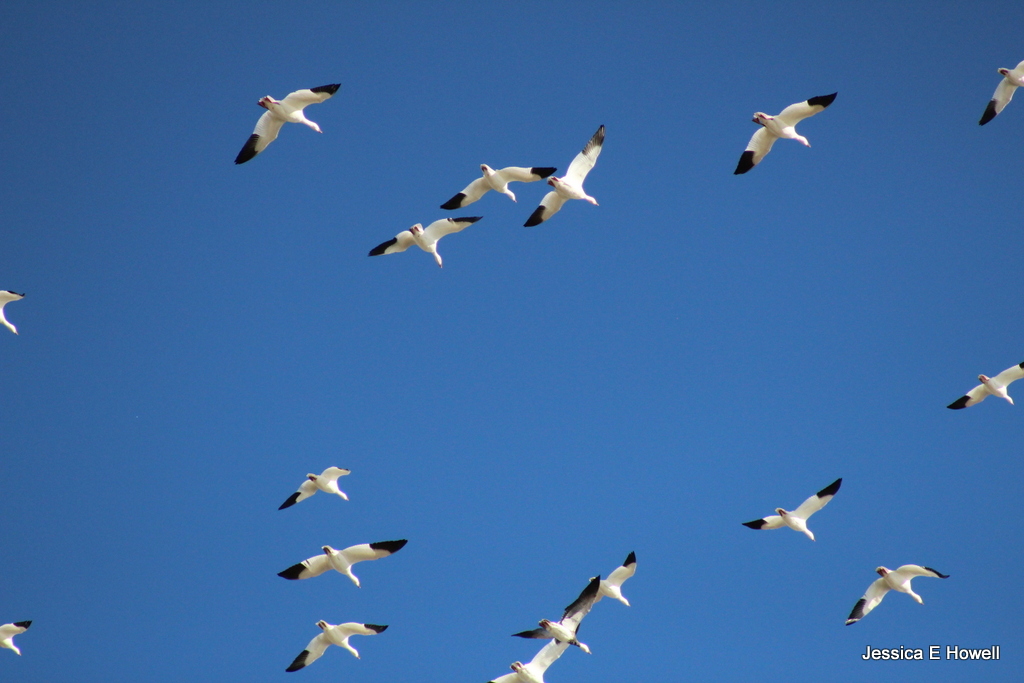
     After leaving the parks, the next day we found ourselves in the middle of the mass Snow Goose migration in Saskatchewan.  These birds breed in the Arctic, then head south to both coasts of the US, as well as parts of central US and Mexico.  Their population is booming, because they thrive in agricultural areas like Saskatchewan.  We stopped the car.  I stood, looking up in awe, at the thousands of birds flying over me.  They called loudly as they flew.  As I looked around, every pond in the fields around us seemed to contain mixed flocks of Snow Geese, Greater White-fronted Geese, Tundra Swans, and ducks.  We saw many more Snow Geese flocks, in such great numbers they blanketed the ground like snow, as well as a field full of Sandhill Cranes, and a large flock of Red-winged Blackbirds settling into a hay field to roost for the night.

Snow Geese

Many, many more Snow Geese.

Sandhill Cranes

Red-winged Blackbirds.

     After a long trip, we were happy to enter Montana on October 15th.  Soon we saw Pronghorn, which I always watch in admiration.  They are the fastest land animal in the Western Hemisphere.  The predator that fueled their evolution of speed, the American Cheetah, no longer exists.  The only animal that can outrun them today, in fact, is the Cheetah.  They are the sole member of their family, and look more like African fauna.  Back in the land of Pronghorn, raptors, and blue skies, I found myself looking into the eyes of a large, new life bird, the Ferruginous Hawk.  Its bill was eagle-like, and I was excited to observe this species for the first time.  We explored the Charles M. Russell National Wildlife Refuge, and watched a herd of several hundred Elk court.  I had never heard Elk bulls bugel, but on this night I finally had the privilege to.  The sound is as wild and beautiful as the call of the loon and the howl of the wolf.  I am still longing to hear the latter.  These are some of nature's greatest concerts, and the quintessence of wilderness.


     We are now home, and I am left to reflect on the amazing experiences this year has brought.  I am incredibly blessed to be able to explore these places and see these species. I also have a wonderful partner to go on adventures with.  Below, you will find a list of all of the species we saw on our trip, when and where we first sighted them, and how many (often approximately) we saw.  Although our trip south has ended, life is a constant adventure, and we can still find intimate moments with nature every day.  We have only to look around us.

-Jess