Tuesday, October 20, 2015

The Drive South

     The boreal forest had grown quiet; the robins and Varied Thrushes no longer sang from the tree tops, the warblers no longer flashed bright yellows in the brush, the White-crowned Sparrows no longer scampered across the ground digging up insects.  The birds had flown south.  It was no secret; it was clear in the falling leaves, in the increasingly cold and dark mornings, and in the spawned out, dying Sockeye salmon.  Summer was over, and winter was quickly coming.
   
     During my last several weeks in King Salmon, I felt like a bird.  Restless, energetic, and somewhat anxious, I wondered if I was experiencing Zugunruhe.  This is a phenomenon seen in many migratory birds; it is the urge to migrate exhibited in nighttime restlessness.  With each passing day, I became more anxious to start my journey south.  Fittingly, I began my migration at night as many birds do, on September 28th.  I flew into Fairbanks to meet up with my mate; we would travel as a pair.

     The need to head south was readily apparent, as a storm had dumped several feet of snow over Fairbanks and was still hanging over the Alaska Interior.  We slowly trod through the snow to Chena Hot Springs.  It was the wildest swimming experience I'd ever had; I swam through hot water, my feet brushing against gravel on the floor, surrounded by rocks and spruce, snow falling.  The air temperature was in the 30s.  Ducks flew over in the twilight, so close I could hear their wing beats.  It was magical.  Our plan had been to head to Denali National Park, but with the storm we were forced to reroute down the Richardson Highway.  We entered into a Winter Wonderland; the snow danced in the wind, and the mountains were all white.  We had a Moose cow and calf trot across the road in front of us, a Beaver swim by our campsite as we made dinner one night, and Gray Jays (also known as Camp Robbers) scold us for not sharing our meal.  As we neared Tok, Alaska, we saw a small patch of blue sky cut out of the gray.  As we rounded a mountain pass, we entered into full blue skies and the snow disappeared.


Chena Hot Springs (Photo from Google Images)

Moose crossing the Richardson Highway.

Winter Wonderland

     We headed into the Yukon on the fourth day of our journey.  The mountains seemed to grow ever larger as we traveled down the ALCAN Highway.  We camped out at Destruction Bay, right next to the beach, and made smores under the Northern Lights!  The next morning soon after we began driving, we came across a herd of 165 Dall Sheep on the side of a mountain.  There were so many of them one could almost mistake them for patches of snow.  We enjoyed counting them, and from a conservation perspective, it is encouraging to see such a big group of large mammals.

Sunset over Destruction Bay, Yukon

Portion of the 165 herd of Dall Sheep.

Along the Haines Junction, British Columbia

     We had not been prepared to leave Alaska yet, so we took a detour to Haines, a southeast Alaska coastal town.  We reached Haines only after driving down mountain passes among some of British Columbia's great peaks.  It was a sharp transition to sealevel, and a breathtaking one.  Towering, jagged mountains with the ocean is one of my favorite landscapes.  Haines brought us sightings of Harbor Seals, seaducks, many, many eagles, and more of the Aurora borealis.  I basked in the glory of the Northern Lights, so beautiful that it almost brought tears to my eyes.  The sky appeared fluid; the lights changing by the second- undulating and pulsating in brightness.  I was mesmerized as it stretched over the mountains and trees.  Perhaps the only thing I was truly aware of whilst in this trance, was how incredibly small I was standing underneath the heavens.

Haines, AK

Bald Eagle in Haines, AK.

I actually took this photo on a different night, but still.

     After a few days, we said goodbye to Alaska for the season and headed back into British Columbia.  We entered the Yukon again briefly, took a dip in Takhini Hot Springs, and afterwards watched the Northern Lights dance again above.  We saw Elk and Caribou, two of my favorite Cervid (Deer) species.  Soon after I restated (we had discussed the subject while in Alaska) that I would love to see Wood Bison (the Northern, forest-dwelling subspecies of the American Bison), we saw a large bull grazing on the side of the road.... And then another one....  And then several more....  And then a herd of over 20!  In total we saw 104 members of what is known as the Norquist Herd.  After another delightful dip in Liard Hot Springs, a secluded natural spring surrounded by moss and spruce, even more excitement came when we read about Stone's Sheep on a sign.  This is a little-known subspecies of the Dall Sheep with a tiny range between southern Yukon and northern British Columbia.  I immediately felt the need to see this animal that moments before I had not known existed.  Its beauty and the possibility of seeing an animal very few others had seen fueled me.  We did not have to wait long.  As we crested a hill along Stone Mountain Provincial Park, a herd of Stone's Sheep were licking salt off of the road.  They looked completely different from Dall Sheep.  Rather than all white, they had black tails, gray backs, and half dark brown and white legs.  We were able to watch the animals at our leisure, and it was a privilege to do so.

Wood Bison bull


Liard Hot Springs (Photo from Google Images).

Caribou


     After some awesome mammal experiences, it was time for some birding.  We were unable to catch up with many of the migrants, but after camping at Swan Lake Provincial Park in Alberta, we woke up to the honking of Canada Geese flying over.  We exited the Mountain Turtle to find Green-winged Teal, Northern Pintails, Northern Harriers, and a Common Snipe.  The quacking of waterfowl and chattering of chickadees and redpolls replaced the silence felt farther north.

     Soon we found ourselves in Jasper and Banff National Parks again.  Here we were unfortunately reminded of the extreme disconnect most of society has with nature as two tourists approached a giant bull Elk.  Not only is it very dangerous to approach a large wild animal, it is also very disrespectful.  Even if wildlife are not visibly stressed by our presence, their heart rates and stress hormone levels are probably increased.  Despite that frustrating situation, we saw many Elk, deer (White-tailed and Mule), Bighorn Sheep, Mountain Goats, a Moose at Moose Pond, and a Black Bear, all while traveling in the shadow of the Canadian Rockies.

Jasper National Park, Alberta

Bighorn Sheep ram in foreground and ewe in background.

Elk bull running.

     After leaving the parks, the next day we found ourselves in the middle of the mass Snow Goose migration in Saskatchewan.  These birds breed in the Arctic, then head south to both coasts of the US, as well as parts of central US and Mexico.  Their population is booming, because they thrive in agricultural areas like Saskatchewan.  We stopped the car.  I stood, looking up in awe, at the thousands of birds flying over me.  They called loudly as they flew.  As I looked around, every pond in the fields around us seemed to contain mixed flocks of Snow Geese, Greater White-fronted Geese, Tundra Swans, and ducks.  We saw many more Snow Geese flocks, in such great numbers they blanketed the ground like snow, as well as a field full of Sandhill Cranes, and a large flock of Red-winged Blackbirds settling into a hay field to roost for the night.
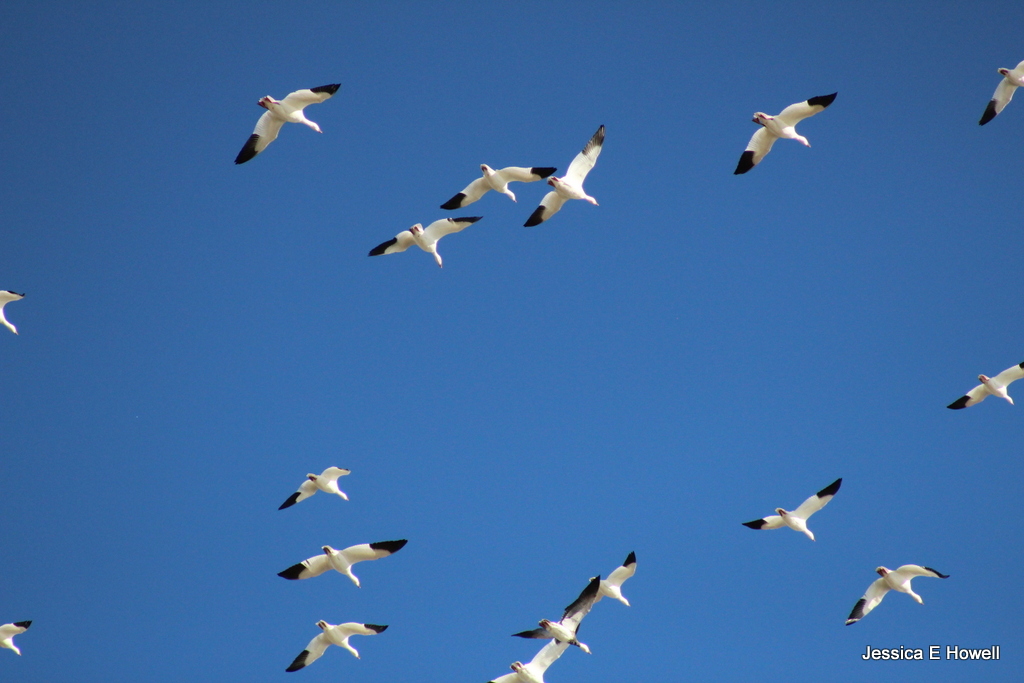
Snow Geese

Many, many more Snow Geese.

Sandhill Cranes

Red-winged Blackbirds.

     After a long trip, we were happy to enter Montana on October 15th.  Soon we saw Pronghorn, which I always watch in admiration.  They are the fastest land animal in the Western Hemisphere.  The predator that fueled their evolution of speed, the American Cheetah, no longer exists.  The only animal that can outrun them today, in fact, is the Cheetah.  They are the sole member of their family, and look more like African fauna.  Back in the land of Pronghorn, raptors, and blue skies, I found myself looking into the eyes of a large, new life bird, the Ferruginous Hawk.  Its bill was eagle-like, and I was excited to observe this species for the first time.  We explored the Charles M. Russell National Wildlife Refuge, and watched a herd of several hundred Elk court.  I had never heard Elk bulls bugel, but on this night I finally had the privilege to.  The sound is as wild and beautiful as the call of the loon and the howl of the wolf.  I am still longing to hear the latter.  These are some of nature's greatest concerts, and the quintessence of wilderness.


     We are now home, and I am left to reflect on the amazing experiences this year has brought.  I am incredibly blessed to be able to explore these places and see these species. I also have a wonderful partner to go on adventures with.  Below, you will find a list of all of the species we saw on our trip, when and where we first sighted them, and how many (often approximately) we saw.  Although our trip south has ended, life is a constant adventure, and we can still find intimate moments with nature every day.  We have only to look around us.

-Jess


Tuesday, September 8, 2015

Close Encounters of the Ursine Kind; Lessons I've learned from Bears

I felt as though I was being watched.  I turned around.  I saw her immediately, staring right at me, not 20 yards off.  My heartrate quickened, and I began to tremble.  The golden colored, subadult female Brown Bear started to walk toward me….

     Bears.  I knew their general biology (large, omnivorous mammals, hibernators, extensive maternal care, etc.), but until I came to Alaska this was my knowledge base.  My experience was limited to zoo trips and several sightings of both Brown (Ursus arctos) and Black Bears (Ursus americanus) in Yellowstone National Park.  There is a growing population of Black Bears in Eastern Ohio, but it is still so small that many residents of my home state probably do not know it exists.  The species is classified as endangered there.  Conversely, the striking statistic often quoted for the Alaska Peninsula is that there are more bears (Brown) than people.  If you spend a summer on the Peninsula as I have done, sharing the same main protein source as bears (salmon), you will undoubtedly interact with these non-human neighbors.  These creatures are powerful not only in physical strength but in their influence on human minds and cultures.  If you look inside a bear's mouth (preferably not by the way I'm sure you are thinking about), you will see that aside from enlarged canines, it's teeth look similar to ours.  They are omnivores like us.  If you examine a bear's tracks, you will notice that they are five-toed like ours, and have smaller front than hind paws, like our hands and feet.  Sometimes they stand and even walk on their hind limbs like us.  Finally, if you spend time closely watching a bear, you might see certain behavioral similarities as well.  At this point I've spent a lot of time watching bears, and along with a mysterious wild wisdom, there is something strangely familiar in the eyes of a bear.  


     In many Native American cultures, the bear is a symbol of the wild, emotional side of ourselves.  Bears are typically solitary animals except for mothers with cubs.  Mystery surrounds the being that wanders the mountains alone; we can relate to a need at times for solitude and introspection.  On my trips into the Becharof National Wildlife Refuge wilderness last summer, bears were often the only other mammal seen each day, and aside from a mother with two cubs, each was alone.  I didn't know anything about these individual bears, except that they were powerful and deserved respect and distance.  My coworker explained how each bear has its own personality, and might respond to our presence differently on one day over another because “Bears have good and bad days too”.  If a smaller bear is chased numerous times by a larger bear, it might be more likely to stand its ground or become aggressive towards us (although this is rare).  Some bears would run immediately as they saw us or picked up our scent, others would stand and watch us.  It was clear that both we humans and those bears could feel the tension between our species.  We tread an invisible line; a delicate balance formed from a long history of competition and combat. 

     Bears show intense, arguably emotional, responses to different stimuli.  From the raised platform at Brooks Falls in Katmai National Park, I’ve been able to observe wild bears closely for hours.  I've watched a bear slap the water with anger after having a fish stolen from her, a mother charge a much larger boar (male bear) without hesitation as he came too close to her cubs, and many other conflicts.  I've seen a cub cry for its mother after being left in a tree, and I've seen footage of a mother in severe distress as her cub was killed by a boar.  I've also watched bears play; jumping on tree limbs and wrestling with each other for hours.  I've seen desperate hungry lunges at fish and genuine pleasure while stripping the skin off of a Sockeye Salmon.  I've seen pain and amazing recoveries from severe injuries.  

The boar on the left came too close to the sow that the bear on the right was courting.

The sow at the top right is growling at the other because she stole her fish.

The fierce look of a mother bear (her 3 cubs are outside of this frame).

Two young bears play in Brooks River.

A look of hunger and triumph.

Enjoying salmon.

Hungry cubs grab at a fish mom just caught.

Below: Contrast the face of Brooks Camp Bear #410 Four-ton, who is 26 years old, with Bear #500 Indy, a young subadult female (who is also who walked toward me in my introductory narrative).


One of many stories of perseverance and survival: Bear 130 Tundra suffered what appeared to be a superficial facial injury as a yearling cub.... (Photo by NPS)

She lived with only a scar to show.... (Photo by NPS/Mike Fitz)

It wasn't until after her death that biologists realized that her injury was not superficial.  130 Tundra had been living with a major skull deformity, perhaps from a blow to the head, that likely caused severe pain (Photo by NPS).


     Through these experiences, watching the lives of bears and interacting with them on occasion, I’ve learned a lot.  I will discuss three important lessons.  The first is to be strong.  This may seem immediately obvious, but it runs deeper than being able to knock a tree over.  130 Tundra and others have recovered from major injuries, showing resiliency and perseverance through struggle.  Bears continue on even when they are in pain.  

     Second, bears have taught me to face my fears, to stay calm in potential danger.  When I first came to Alaska and started to read Stephen Herrero’s Bear Attacks: Their Causes and Avoidance, the fact that bears are dangerous animals that can kill people began to cause a sick feeling in my stomach; fear.  Training in bear biology and behavior, how to react when encountering a bear, and bear spray and firearms helped build confidence, but I still nervously anticipated my first encounter.  It was on my second field mission to take a survey of bird species and abundances.  I had seen bear trails and scat on my first, but no bears.  I was canoeing the Kejulik River with my coworker to our field site.  It was cold, wet, and windy; so miserable that both of us had ceased speaking and my thoughts were of warm places and a longing to be curled up in my sleeping bag.  I heard “Bear”, in a serious tone and looked ahead to see a giant dark figure on the shore downstream from us.  I shook not from the cold now, knowing that we would have to canoe by the bear.  The mighty creature took one look at us and then turned and ran up a hill with such ease that I was entranced by its power.  We saw many bears on that trip, and I’ve seen many bears since, but there are several encounters that stand out in my mind.  

It is a humbling moment to have eye contact with a large, sentient, nonhuman being; both of us are mutually aware of each other, and both of us are curious and afraid.  In addition to facing my fears, bears have taught me humility.  I am reminded of my small size (in both a literal and abstract sense) when in the presence of bears.  Returning to my introductory narrative; I was on my way back to Brooks Camp after a walk on the beach and had walked into the forest to examine a beaver pond when I turned to see a young bear.  She was obviously a curious subadult by her small size and approach; head up and an unsure walk.  I talked to her, repeating “Hey bear” and “Stay back” in as firm a voice as I could manage.  I had to make several turns, returning to the beach before she finally lost interest.  I will never know her motivations beyond curiosity, but she looked lonely and confused by my hostility.  Subadult bears are chased away by their mothers and must learn to survive on their own.  I hoped that I had helped to teach her an important lesson; to stay away from humans. 

The subadult female after she had stopped following me.

There is much we can learn from bears.  If the bear represents our wild side, then are we left confused like the subadult female?  Do we fear the darker side of our own nature, or do we turn and look it in the eye?  We will likely never completely understand, but we can acknowledge our different sides and grow.  The very essence of wild is intangible, and therefore unattainable.  We are left to wander, respecting the bear and learning when to use its power.  


Sunday, July 19, 2015

On the Tail of the Wolf

      Animals inspire emotions in us, rooted in instinct and grown in culture, personality, and perspective.  Trying to find our place in a rapidly changing world, one that suffers from an illusioned disconnect and distorted relationship with that intangible thing we call nature, we attempt to relate to and connect with other species.  We identify with hunger, fear, play, comfort, and more that we see reflected in the behaviors of other organisms.  We feel sad when we see a scrawny cat sifting through garbage, and heartwarmed when observing a mother robin feeding her nest of chirping chicks.  However, I believe the strongest emotions emerge when we encounter a predator.

     The word predator sounds menacing, having many negative connotations in our society.  Predators evoke our most primal instinct: fear.  They cause conflict within us because they force us to confront our own consumptive, destructive nature.  The greatest disconnect perhaps lies here; predation is an inconvenient truth that we do not often acknowledge.  To see that this is true, one only needs to consider media portrayals of these animals- villanized in children's movies and often edited in documentaries to exclude gruesome realities.  How many of us can say we have witnessed a true predation event occurring before our eyes?  How many more of us can say that given the opportunity, we would not interfere?

Wolves close in on an Elk in Yellowstone National Park (Google Images).

     All large predators have been eradicated in my native state of Ohio.  The Gray Wolf (Canis lupus) once ran through deep forests there, but European settlers carried with them to America a strong fear of those deep forests and the beasts in them.  Human nature is to destroy what we fear and do not understand, and when combined with a hunger for revenge over livestock losses and competition over game, the wolves really didn't stand a chance.  In the late 1800's, bounties were set in Ohio along with the rest of the country.  These were often government sanctioned programs; at $20-$50 per wolf, thousands were quickly taken by poisoning, trapping, hunting, and more graphic methods.  We annihilated them.

The late 1800's through mid-1900's involved a mass extermination effort (PBS).

     From the 60's until now wolf-human relations have improved- an estimated 5,000 wolves roam 6 of the lower 48 states, with small populations in 4 more.  Wolf reintroduction to Yellowstone (they were eradicated from the park in 1926) ended overgrazing by elk and consequently altered the entire hydrology of the park as well as improving survivorship of many other species.  Despite these improvements, we still have literal conflicts as well as mental blocks.  Wolves are still demonized in media and pop culture; Animal Planet's Man-Eating Super Wolves from "Monster Week" 2014 and the wolf pack chase scene from Disney's Frozen (2013) are two recent examples.  The Gray Wolf is perhaps the most controversial species today.  Strong opinions run on both sides; with wolf advocate nonprofits such as Wolf Watcher and Howling for Justice as well as antiwolf groups like Save Elk and Washington Residents Against Wolves.   A strange combination of federal protection and state managements complicates things even further.
The famous wolf scene from Beauty and the Beast (Google Images).

Anti-wolf propaganda from Washington state (Google Images).

     With the Gray Wolf's history and current situation, it is fitting that they are very elusive creatures.  Ever since I read a ZooBook on wolves when I was very young, I've been fascinated by these animals.  Wolves are highly social animals that live in packs consisting of parents (the Alpha pair) and often several generations of young.  I thought a lot about this, wolf hunting strategies, and our species' most tangible link with theirs; domestic dogs.  I read about communication through posture, facial expression, and tail position, studied these behaviors in one of my own pack members (my Husky-Chow-Sharpei mix named Phoebe), and successfully communicated a will to play (by bowing with arms outstretched) to both my dog and several captive wolves at Columbus Zoo.  Both of those cases ended with canine(s) and human happily running back and forth at each other in a sort of "tag" (in the case of the wolves between a fence).  Through these experiences, book learning, and the adoption of the wolf as a symbol of my nuclear family (Howell is pronounced as Howl), I formed an association of the wolf with deep meanings of family, love, power, and wilderness.  As I grew older, the desire to travel and see these animals in the wild grew stronger and stronger.

Wolf and Laborador demonstrate the play stance (Google Images).

A pack socializing (Google Images).

     In 2012, while on a family roadtrip, I visited Yellowstone National Park for the first time.  We worked as a pack; driving through Lamar Valley in our red Prius multiple times, hoping to see a wolf pack crest a hill or stalk a group of Pronghorn by a stream.  We saw both Black and Grizzly Bears, Elk, Pronghorn, Coyotes, and Moose, but no wolves.  I would not be in Gray Wolf range again for two years.
Coyote in Yellowstone National Park.

Gray Wolf (black morph) at the Colorado Wolf and Wildlife Center.

Mexican Wolves, a disappearing subspecies, at the Columbus Zoo.

     In 2014 I journeyed to Alaska for the first time to work for USFWS Alaska Peninsula and Becharof NWRs.  I flew into a town with a year-round population of around 350, surrounded by tundra, with mountains to the south and Bristol Bay to the north.  King Salmon is connected to the nearby town of Naknek by a single paved road (the Alaska Peninsula Highway).  Outside of these towns is what I would call wilderness; surely wolves roamed this land.  I was told that wolf sightings here were still rare; wolves generally stayed away from town.  I eagerly hoped for a sighting all summer, scanning the tundra below from the refuge's Husky (small, fixed wing plane) and hill and mountain-sides from the ground on field missions.  Alas, I saw no wolves that summer.  That fall I visited Yellowstone again, as well as other parts of Montana on a fantastic roadtrip.  I again saw the Gray Wolf's close relative, the Coyote (Canis latrans) but not the wolf itself.

     Driving up to Alaska in spring of 2015, I still held high hopes of seeing a wolf, but did not search as fervently.  I saw many amazing animals on that adventurous trip as well, but no wolves.  By the time I had reached King Salmon and was flying to Brooks Camp in Katmai National Park for training as an interpretive Park Guide, my mind was on bears.

     Brooks Camp is where almost every picture of a bear catching a salmon over a waterfall is taken.  As many as 70 bears roam the area in July and September, and the landscape is as awe-inspiring as its residents.  I expected to see bears, and I understood that wolf sightings here were rare.  However, the 3rd day we were at Brooks, a coworker excitedly and exasperatedly announced that she had seen a wolf at the falls.  I immediately power-walked to the falls to look for the wolf, which was either long gone or out of sight.  The next day, large, fresh canine tracks lined the beach.

     A week passed by without incident.  I read a book by David L. Mech, a famous wolf biologist, called The Arctic Wolf: Living With the Pack, and dreamed as I had done since I was a child of living among wolves.  I walked outside on a break from training one day and was told by another coworker that a wolf had been spotted on a trail nearby 15 minutes earlier.  Needless to say, it was very difficult for me to go back to work.  Time was running out- I would return to King Salmon in a few days, yet I was so close to seeing a wolf!

     While on a informational walk-around during my last full day at Brooks Camp, I heard a gargled transmission from a coworker's radio.  "Wolf.... lower river.... marsh."  I spun around with wild eyes.  Once again, we were not allowed to leave training.  I stewed, imagining that in this frenzy I turned into a wolf and ran away, wild and never to be bound by rules again.  I will admit that I did not listen to or retain well most of the information that was spoken to me that afternoon.  However, I had dinner at the lodge that evening, which overlooks the lower part of Brooks River.  As I gorged myself on French fries like a wolf on a freshly killed moose, I heard someone say the wolf was on the river again.  I leapt from the table and ran as fast as I could outside, heart pounding.  I only glimpsed the animal for a moment as it trotted from the marsh into the woods, but I saw it.

     I was happy, but I wanted more.  I can't explain why, but somehow I knew I needed to walk to the lower river platform at dusk.  I walked across the bridge with purpose, listening to shorebirds agitatedly calling.  "What's their problem?  Could a predator be around?" I thought.  I scanned the riverbank with my binoculars, and suddenly he came into view.  The wolf, almost white on the back and with hints of rust on the sides and a black patch on the tail, was walking the bank.  He came down for a drink, then sniffed the wind coming from my direction.  I was ecstatic!  I watched him walk for a few minutes, and then with my heart still pounding and a smile on my face, I got out my camera and took a few shots.  He was so beautiful and magnificent, and I admired how easily he was lost in the grasses.  Just when I thought things couldn't get better, as he disappeared I scanned farther upriver and spotted another wolf standing at the edge of the forest.  Eventually the two met in the middle of the river, playfully greeting and then trotting upstream.  It was magic in the twilight.  I was in disbelief, and felt elated that a life goal had been met.  After they moved out of view, I walked back smiling.  "Why do you have binoculars?  You couldn't have been birding this late."  A friend asked when I returned to camp.  "What did you see?"  My triumph was cheered, and I was still so excited hours later that I didn't fall asleep until very late that night.


     I've now seen the Gray Wolf in the wild; a graceful animal and not a monster, beautiful and mysterious as in legend.  I share this in hopes that others will feel admiration rather than fear of this animal.  Now that I have finished this quest, my next challenge is to see a pack, and observe for a longer period.  I will always be on the tail of the wolf.